

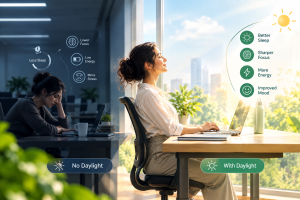

Employees with windows in their workplace received 173% more white light exposure during work hours and slept an average of 46 minutes more per night than colleagues in windowless offices, according to Northwestern Medicine research published in the journal SLEEP. Workers without windows also scored measurably worse on quality of life measures related to physical problems and vitality, along with poorer overall sleep quality and more sleep disturbances.
Forty-six minutes of sleep per night is not a marginal difference. Over a working week, that’s nearly four hours, and it’s attributable to something most organizations treat as a purely architectural or real estate consideration rather than a wellbeing one. Daylight may be the most overlooked variable in workplace design, and the research behind it is considerably stronger than most people realize.
Why Light Is a Biological Input, Not Just a Comfort Preference
Light is the primary environmental cue regulating circadian rhythms, the roughly 24-hour internal cycles governing sleep-wake patterns, hormone release, body temperature, and blood pressure. Exposure to light signals the brain when to secrete cortisol and serotonin, preparing the body for daytime activity, and when to produce melatonin, which triggers sleep onset.
This is what separates daylight from a simple aesthetic preference. An employee working under insufficient light isn’t just in a less pleasant room; their body is receiving weaker or mistimed signals about when to be alert and when to wind down. Given that people in modern societies spend roughly 87% of their time indoors, indoor light conditions have effectively become the primary input regulating a biological system that evolved around the sun.
“There is increasing evidence that exposure to light, during the day, particularly in the morning, is beneficial to your health via its effects on mood, alertness and metabolism,” noted Dr. Phyllis Zee, the Northwestern Medicine neurologist and sleep specialist who served as senior author on the windowless-office study. The researchers specifically flagged office workers as an at-risk group, precisely because they’re typically indoors all day, often without access to natural or even artificial bright light.
What the Research Actually Shows
Cognitive performance, not just comfort, improves measurably with better daylight. A study of 30 knowledge workers, published in peer-reviewed research, had participants spend one week each in two identical office environments, same layout, same furnishings, same orientation, differing only in glazing: one used electrochromic glass, the other traditional blinds, producing 316 versus 40.6 equivalent melanopic lux respectively. Participants in the optimized daylight condition slept 37 minutes longer as measured by wrist-worn actigraphs and scored 42% higher on cognitive simulations designed to test higher-order decision-making performance. A 42% difference in complex decision-making, driven by nothing but the glass in the windows, is a remarkable finding.
Morning light specifically matters most. Research conducted across five US General Services Administration buildings with 109 participants found that office workers receiving high levels of circadian-effective light in the morning experienced reduced time to fall asleep, especially in winter, along with better circadian entrainment and improved sleep quality compared to those receiving low morning light exposure.
Even in windowless spaces, lighting design choices measurably matter. Research comparing LED versus fluorescent task lighting in windowless offices found that lighting with higher melanopic content, meaning light more effective at stimulating the circadian system, produced measurably different sleep quality and daytime function outcomes. This matters practically, because it means organizations without the option to add windows still have meaningful, evidence-backed choices available to them.
Mood and anxiety outcomes track with light access too. Separate research analyzing hundreds of employees found sunlight exposure at work linked to lower depressed mood and anxiety alongside higher job satisfaction and organizational commitment, with direct sunlight most strongly predicting reduced anxiety and indirect natural light most strongly predicting lower depressed mood.
“In short, we spend enormous effort on wellness programs while employees sit under lighting that’s quietly working against their sleep every single day. Daylight is one of the cheapest interventions available, and one of the most ignored.” — Mr. Amit Kapoor, Founder Of Balanz & Beonn
Why This Gets Overlooked
It’s a real estate and facilities decision, not a wellness one. Window access, floor plate layout, and lighting specification typically get decided during office design or lease negotiation, long before anyone in HR or wellbeing is consulted, and rarely with health outcomes as an explicit criterion. The result is that a decision with measurable effects on sleep, mood, and cognitive performance gets made by people evaluating cost per square foot.
Window access is often distributed by seniority rather than need. In many offices, proximity to windows correlates with organizational rank, private offices along the perimeter, open-plan seating in the interior, meaning the employees with the least control over their environment often have the least daylight access too. That’s rarely an intentional wellbeing decision, but it’s a consistent pattern with real consequences.
The effects are delayed and easy to misattribute. Poor daylight exposure shows up as worse sleep that night and lower alertness the next day, not as an obvious complaint about the office. An employee experiencing chronic fatigue is far more likely to attribute it to workload, stress, or their own habits than to the lighting conditions they spend eight hours a day inside.
What Organizations Can Actually Do
- Treat daylight access as a wellbeing criterion in office design and seating decisions, not just a real estate variable, and consider distributing window access based on how long people sit at a desk rather than purely by seniority.
- Prioritize morning light exposure specifically, given how consistently research identifies morning circadian-effective light as the most beneficial timing for sleep and alertness outcomes.
- Invest in circadian-appropriate artificial lighting where windows aren’t possible. Since the research shows lighting with higher melanopic content produces measurably better outcomes even in windowless environments, this is a genuinely actionable option for basement, interior, or converted spaces.
- Encourage short outdoor breaks during daylight hours, which deliver light exposure the indoor environment may not, and pair a physiological benefit with the movement benefits short breaks already provide.
- Treat lighting as core corporate wellness infrastructure, not a facilities afterthought. A genuinely comprehensive wellness strategy accounts for the physical environment employees actually sit in, since the research shows it directly shapes the sleep and energy outcomes wellness programs are already trying to improve.
Some organizations are working with a specialized corporate wellness company to assess this properly, evaluating light exposure alongside ergonomics and movement as part of a coordinated approach to physical workplace design, rather than treating lighting as a purely architectural question disconnected from employee health outcomes.
The Bottom Line
Does your workplace give employees enough daylight? For a significant share of office workers, the research suggests the answer is no, and the consequences are more measurable than most organizations assume: worse sleep, lower vitality, higher anxiety, and in at least one controlled study, a 42% difference in higher-order decision-making performance. What makes this particularly worth addressing is how unusually favorable the cost-benefit looks. Unlike most wellness investments, improving daylight access often requires no ongoing program, no vendor contract, and no employee participation, just deliberate attention to something organizations are already deciding anyway, usually without considering health at all.
There’s a broader point here about how workplace wellbeing gets budgeted. Organizations routinely fund apps, webinars, and awareness campaigns while leaving the physical environment, lighting, seating, air quality, movement opportunity, entirely to facilities teams optimizing for cost and space efficiency. The daylight research is a useful corrective, because the effect sizes it produces are larger and better documented than many of the interventions that do get wellness funding. A workforce sleeping 46 minutes less per night and making measurably worse complex decisions isn’t a problem a mindfulness subscription was ever going to solve. It’s a design problem, and it responds to design solutions.