

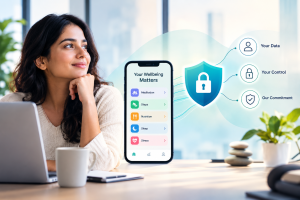

Imagine an employer announces a new wellness app. It offers guided meditation, step challenges, health tips and a place to track sleep and stress. On paper, it is a thoughtful addition to the benefits list. In practice, many employees pause before downloading it, and the question in their minds is rarely about the features. It is: “Who can see what I put in here?”
That hesitation is worth taking seriously. A wellness app only works if people actually use it, and people only use it honestly if they trust it. For any organisation investing in corporate wellness, trust is not a nice extra. It decides whether a programme is embraced or quietly ignored.
So is data privacy the biggest barrier? It is certainly one of the largest, and often the one that sits underneath all the others.
Why wellness data feels so personal
Most apps collect some data. Wellness apps collect a particular kind. Sleep patterns, mood check-ins, stress levels, fitness routines, health goals and sometimes information about medical conditions all say a great deal about a person’s life.
This is not the same as a shopping preference or a music playlist. It is information that people may not share even with close friends, let alone with a manager or an HR team. When the app is offered by an employer, the sensitivity increases, because of a simple question employees quietly ask: “Could this ever affect how I am seen at work?”
That question is the real source of the trust gap. Even when no such misuse is planned, the possibility alone is enough to make people hold back.
The employer-employee dynamic
In a normal consumer setting, a person downloads an app, reads (or skips) the terms and decides for themselves. A workplace app is different. The employer chose it, the employer promoted it, and the employer may receive reports from it.
This creates a natural power imbalance, even in organisations with excellent intentions. Employees may worry that:
- Their individual health or mood data could be visible to managers or HR.
- Low participation might be noticed, or high participation might be expected.
- Information shared in a vulnerable moment could be used in appraisals, role decisions or promotions.
- Data could be shared with third parties such as insurers, advertisers or other vendors.
Most of these fears are about perception rather than fact, but perception shapes behaviour. If employees believe the data is not safe, they will either avoid the app or use it superficially, which defeats the purpose of having one.
The current reality: awareness is higher than ever
People today are more aware of digital privacy than they were even a few years ago. Data breach headlines, spam calls, targeted advertising and discussions around consent have made many employees more careful about what they share and with whom.
India has also moved towards a clearer legal framework with the Digital Personal Data Protection Act, 2023, which emphasises consent, purpose limitation and the responsibilities of those who handle personal data. For organisations, this means that privacy is no longer just a matter of good manners. It is part of responsible governance, and employees increasingly expect their employer and its wellness partners to treat it that way.
At the same time, hybrid work, wearables and always-on devices mean more personal information is generated every day. The question is not whether data is collected. It is how thoughtfully it is handled.
Is privacy really the biggest barrier?
Privacy is a major barrier, but it rarely travels alone. Other factors also shape whether employees trust and use a wellness app:
Relevance. If the content feels generic or does not fit a person’s daily life, they will not return, regardless of how secure the app is.
Time and fatigue. Busy employees already juggle many tools. A wellness app that feels like one more task is easy to ignore.
Cultural stigma. In some workplaces, talking openly about stress or mental health is still uncomfortable. A privacy concern can be the practical form of a deeper reluctance.
Unclear purpose. When employees do not know why the app exists or what the company hopes to gain, suspicion fills the gap.
Poor experience. A clunky interface or frequent technical issues damage credibility quickly.
Seen together, privacy works like a gatekeeper. If it is not addressed, the other benefits never get a chance to matter. If it is addressed well, the others become much easier to solve.
What builds trust in a wellness app
Trust is not created by a line in the terms and conditions. It is built through consistent, visible choices. Here is what tends to matter most.
Clear, plain-language communication. Employees should be able to understand, in a few sentences, what data is collected, why, who can see it and how long it is kept. Long legal text that nobody reads does not build confidence.
Voluntary participation. A wellness app should be an invitation, not an obligation. When joining is optional and opting out carries no consequences, people feel safer engaging.
Anonymised and aggregated reporting. Employers generally need to know whether programmes are working, not what an individual said. Group-level insights, shared only when the group is large enough to protect identity, offer value without exposing anyone.
Strong security practices. Encryption, access controls and regular security reviews are the foundation. Employees may never see them, but leaders should ask for them.
Clear separation from performance decisions. A firm commitment that wellness data will never be used for appraisals, promotions or similar decisions is one of the most reassuring promises an organisation can make, provided it is kept.
Consent that is real. Meaningful consent means people understand what they are agreeing to and can change their mind later.
Data minimisation. Collect only what is needed. The less sensitive information an app holds, the less there is to worry about.
The role of a corporate wellness company
A good corporate wellness company does more than supply content and events. It also acts as a responsible custodian of employee trust. When evaluating a partner, HR and business leaders can ask a few practical questions:
- What personal data does the platform collect, and why is each item needed?
- Who within the employer organisation can see individual-level information, if anyone?
- How is data stored and protected, and for how long is it retained?
- Can employees view, correct or delete their information?
- How is consent captured, and how can it be withdrawn?
- What happens to the data if the partnership ends?
A partner that answers these questions clearly and without hesitation is usually one that has thought about them seriously. Vague answers are a signal to look further.
Why on-ground engagement still matters
Trust is not only technical. It is also human. A wellness app is far more likely to be adopted when it is introduced alongside real conversations, workshops and sessions where employees can ask questions, meet the people behind the programme and see how the app actually works.
This is why many organisations pair a wellness app with on-ground and virtual wellness sessions. A trained facilitator can explain how privacy is handled, answer concerns on the spot and show that the programme exists to support people rather than monitor them. Familiar faces and open dialogue do what no privacy policy can do alone: they make the programme feel safe.
What employees can do
Employees also have a role in protecting their own information. A few simple habits help:
- Read the summary. Even a quick look at what an app collects can clear up many doubts.
- Share what you are comfortable sharing. Most wellness benefits come from regular use, not from entering every possible detail.
- Check the settings. Look for options to manage notifications, sharing and data deletion.
- Ask questions. If something is unclear, ask HR or the programme provider. A trustworthy partner will welcome the question.
A founder’s perspective
Speaking on how privacy shapes trust in digital wellbeing, Mr. Amit Kapoor, Founder, says:
“People will only share honestly with a wellness app if they are sure it is on their side. Privacy is not a technical footnote. It is the foundation of that trust. When employees know their information is protected and used only to support them, they engage more openly, and that is when wellness truly begins to work.”
His point is simple but important: the best features in the world cannot make up for a lack of confidence.
So, is privacy the biggest barrier?
In many cases, yes, or at least the one that must be solved first. Relevance, convenience and culture all matter, but none of them can fully work if employees are unsure about what happens to their information.
The encouraging part is that this barrier is within an organisation’s control. With transparent communication, voluntary participation, responsible data practices and a partner who treats employee trust seriously, privacy can shift from the biggest concern to a clear strength. Done well, corporate wellness becomes something employees see as a genuine benefit rather than something they approach with caution.