
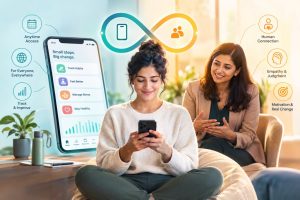
RAND’s analysis of PepsiCo’s corporate wellness program, one of the most cited real-world studies in this space, found that broad lifestyle programming, gym benefits, general wellness apps, screenings, returned roughly $0.50 for every dollar spent, while targeted programs built around real human support returned several times their cost. That gap doesn’t mean apps don’t work. It means the two approaches solve genuinely different problems, and organizations expecting either one alone to carry the full weight of employee wellbeing are likely to be disappointed with the results.
So can a wellness app replace a human wellness partner? The research increasingly says no, not because apps are ineffective, but because the two formats consistently excel at different things, and the strongest outcomes come specifically from combining them rather than picking a side.
What the Research Actually Shows About Each Format
Apps and human coaching produce comparable satisfaction, but different behavioral outcomes. A 2025 review published in Frontiers in Digital Health found that engagement, satisfaction, and working alliance remained largely consistent across both human and AI-supported coaching interventions, but the two diverged in what they were best at. AI-powered coaching showed more consistent positive trends specifically for physical activity levels, the kind of trackable, quantifiable behavior apps are naturally well-suited to support. Human-facilitated coaching showed more consistent results for psychological wellbeing and stress management, the harder-to-quantify, relationship-dependent work that benefits from genuine human judgment and empathy.
Human connection adds something apps consistently can’t replicate on their own. The same review found that participants in blended programs specifically valued human support alongside app-based tools to increase motivation, build confidence, and help them actually navigate the technology itself. Overall, human-facilitated coaching fostered stronger connections and higher satisfaction than automated support alone, even in studies where both formats performed comparably on other measures.
Combined approaches consistently outperform either format used in isolation. A 2026 study in the Journal of Medical Internet Research examining a health coaching app for people managing multiple chronic conditions found that app-based support alongside complementary human coaching enhanced both effectiveness and acceptability, reinforcing the value of pairing consistent, complementary support rather than relying on one channel. A separate multicenter clinical study found that combining a self-management app with human coaching produced significantly better outcomes for weight loss and sleep than either conventional care or app use without the coaching layer.
A university-based blended program found real synergy between the two, not simple addition. Research on a blended mobile health app plus wellness coaching program found participants described genuine synergy: they used the app to process their own reflections and arrive at coaching sessions better prepared, while coaching in turn helped them get more value out of the app between sessions. The two channels reinforced each other rather than simply running in parallel.
Where Each Format Genuinely Excels
Apps are exceptional at consistency, accessibility, and quantifiable tracking. A well-designed app gives every employee, regardless of schedule, location, or seniority, a consistent, always-available way to log habits, track progress, and receive real-time nudges. This scalability is something no human coaching program can match on its own; a coach can meaningfully support dozens of people, while an app can meaningfully support thousands simultaneously, at consistent quality, every single day.
Human support is exceptional at the harder-to-quantify parts of wellbeing. Genuine motivation during a difficult stretch, working through the reasons behind a stalled habit, and the kind of judgment a specific, complicated personal situation actually requires are areas where research consistently favors human involvement. One qualitative study comparing automated and human coaching found human-powered coaching offered clear advantages in empathy and deeper engagement, even though the consistency and predictability of automated support helped some participants stay on track between those human touchpoints.
Neither format solves the engagement-decline problem alone. Digital interventions commonly face declining engagement over time as novelty wears off, while human coaching, though generally stickier, can be harder to scale and schedule consistently across an entire organization. Blended program research found that while both app use and coaching participation each declined somewhat over time individually, the combination sustained overall engagement better than either channel tracked in isolation.
“In short, an app can be with someone every single day. A human can understand why they stopped opening it. You genuinely need both, because they’re not actually competing for the same job.” — Mr. Amit Kapoor, Founder of Balanz & Beonn
Why “Both” Is Becoming the Industry Standard, Not the Exception
Industry analysis heading into 2026 increasingly frames this not as a debate to resolve in favor of one format, but as a design question about how to combine them well. Corporate wellness platforms built purely around broad lifestyle programming, apps, general challenges, screenings, continue to show the weaker RAND-style returns, while platforms structured around real coaching relationships, often delivered through the same technology infrastructure that also handles tracking and reminders, show meaningfully stronger outcomes. The lesson isn’t that apps are the weaker half. It’s that an app functioning purely as a standalone engagement tool, disconnected from any human relationship, tends to underdeliver relative to one that’s genuinely integrated with real coaching, events, and support behind it.
What This Looks Like in Practice
Use the app for consistency, accessibility, and data. Daily check-ins, habit tracking, and always-available resources are exactly where a well-built app earns its place, reaching every employee regardless of schedule or location, something no coaching program alone could match at scale.
Use human support for the moments that actually require judgment. A stalled habit, a personal crisis, a complicated life circumstance shaping someone’s stress or motivation, these are the situations where research consistently shows human coaching and support outperform automated tools working alone.
Build genuine touchpoints between the two, not two disconnected programs running in parallel. The strongest results in the research came specifically from blended designs where the app and the human support reinforced each other, not from simply offering both as separate, unconnected benefits.
This is exactly why corporate wellness events are increasingly being organised specifically to create these human touchpoints, coaching sessions, group workshops, guided check-ins, that connect directly back to the habits and data an employee is already tracking day to day. A genuinely comprehensive corporate wellness strategy treats the app and the human relationship as one integrated system rather than two separate offerings competing for the same budget. Some organizations work with a specialized corporate wellness company specifically because building this integration well, connecting daily app engagement to real human coaching and events, requires more coordination than either an app vendor or an independent coaching program can typically provide alone. A genuinely effective wellness strategy in 2026 isn’t a choice between the two. It’s built on making sure they’re actually talking to each other.
The Bottom Line
Can a wellness app replace a human wellness partner? The research says no, but not because apps fall short. It’s because apps and human support are built for different jobs, consistency, accessibility, and quantifiable tracking on one side, empathy, judgment, and motivation through complicated moments on the other, and the strongest outcomes consistently come from combining them rather than asking one to do the other’s work. Organizations still treating this as an either-or decision are likely leaving real value on the table in either direction. The evidence increasingly points toward blended, integrated design as the standard, not the exception, for organizations serious about employee wellbeing outcomes that actually last.
The practical takeaway for anyone evaluating a wellness strategy is to stop asking which format to choose and start asking how well the two are actually connected. An app with no human layer behind it will keep facing the engagement decline the research consistently documents. A coaching program with no daily digital touchpoint will struggle to reach and support an entire workforce consistently between sessions. The organizations getting the best results aren’t the ones that picked a side. They’re the ones that stopped treating the choice as a competition in the first place.


