
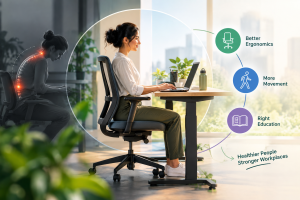
A major 2026 review published in BMJ Open, examining 23 randomized controlled trials involving 2,456 people living with chronic musculoskeletal pain, reached a conclusion worth sitting with: ergonomic chairs and sit-stand desks help, but only when combined with movement, exercise, and education, not as a standalone fix. That finding cuts in two directions at once. It confirms that physical workplace design genuinely matters for health outcomes, while also correcting the common assumption that swapping in a better chair alone solves the problem.
That nuance is exactly where this conversation needs to sit. Your office chair probably is affecting more than your posture, but the honest answer to how much more depends on what else is, or isn’t, happening around it.
The Case That Your Chair Matters More Than You’d Think
Musculoskeletal pain from poor seating is remarkably common. Research on office ergonomics consistently finds that a large share of desk-based workers report chronic discomfort in the neck, shoulders, and lower back, conditions strongly associated with prolonged, unsupported sitting rather than any single dramatic injury. A 2025 study evaluating a redesigned, anthropometrically tailored office chair found statistically significant reductions in musculoskeletal risk scores after implementation, reinforcing that seat design measurably changes physical strain, not just comfort ratings on a survey.
The link between physical discomfort and productivity is direct, not just anecdotal. A semi-experimental study of 247 office workers in Greece, using validated tools including the SF-36 health survey and the Work Productivity and Activity Impairment Questionnaire, found that a workplace ergonomics intervention significantly reduced presenteeism and improved both physical and mental health scores in the group that received it early, with meaningful pain reductions across the neck, shoulders, wrists, and back. The comparison group that received the same intervention later showed no significant improvement in the interim, a genuinely useful natural experiment showing the intervention itself, not simply time or unrelated factors, drove the change.
Discomfort compounds quietly before it becomes visible. Musculoskeletal strain from poor seating rarely announces itself as a single injury. It builds gradually, a stiff shoulder that becomes a chronic ache, a mild backache that becomes a recurring flare-up, until an employee is managing ongoing discomfort as a normal part of their workday without necessarily connecting it back to eight hours a day in an unsupportive chair. That slow, invisible progression is part of why physical workplace design gets underinvested in relative to its actual impact; the cost accumulates silently rather than showing up as a single dramatic event anyone notices right away.
Why the Chair Alone Isn’t the Full Story
The 2026 BMJ Open review’s central finding deserves emphasis precisely because it cuts against a common assumption in corporate wellness spending: that buying better equipment solves the problem. The researchers found the most effective interventions combined three elements together, ergonomic equipment, structured movement or exercise, and education on proper use and posture, rather than any one element working in isolation. A well-designed chair sitting unused, or used incorrectly because no one explained proper adjustment, delivers a fraction of its potential benefit.
This tracks with a broader theme in ergonomics research: the shift over the past two decades has moved away from searching for a single “correct” static posture and toward a more dynamic view that treats movement itself, not just proper seating, as central to reducing strain. A chair that supports good posture while someone sits motionless for six hours still leaves the body in a fixed position for far longer than it’s designed to tolerate well. The chair matters, but so does how often someone actually gets out of it.
“In short, a great chair without any movement or education behind it is still just a comfortable way to stay in a bad routine. Furniture alone was never going to solve something that’s really about the whole workday.” — Mr. Amit Kapoor, Founder of Balanz & Beonn
Why Physical Workplace Design Keeps Getting Deprioritized
It’s treated as a facilities decision, not a wellness one. Ergonomic equipment purchases typically get routed through office facilities or procurement, separate from HR and wellness budgets entirely, which means the connection between seating and measurable health or productivity outcomes rarely gets tracked or communicated as part of a broader wellbeing strategy.
Remote work has fragmented responsibility for it. With a large share of the workforce now splitting time between home and office setups, or working from home entirely, the employer’s traditional ability to control and standardize the physical work environment has weakened considerably. A home office chair, desk height, and monitor position are far less consistent than a company’s own office standards, and few organizations have built clear guidance or support for getting this right remotely.
The return on investment is real but harder to see than other wellness spending. Compared to a wellness app with a visible dashboard or a mental health benefit with clear utilization numbers, ergonomic investment shows up indirectly, in fewer sick days, fewer workers’ comp claims, and better sustained focus, outcomes that are genuinely measurable but require deliberate tracking to actually see, rather than appearing automatically in a standard engagement survey.
What Actually Works, Based on the Research
Pair equipment with training, every time. Given the BMJ Open review’s central finding, any ergonomic investment, a new chair, a sit-stand desk, should come with clear instruction on proper adjustment and use, not just the equipment itself sitting in a box.
Build movement into the day as deliberately as the seating itself. Since prolonged static sitting undermines even well-designed chairs, structured movement breaks, whether short walks or simple stretching prompts, function as a genuine complement to ergonomic equipment rather than a separate initiative.
Extend ergonomic support to remote and hybrid setups explicitly. With home offices now a permanent fixture for a large share of knowledge workers, treating ergonomic guidance and stipends as an office-only benefit leaves a meaningful share of the workforce without the support that’s been shown to matter.
Treat physical workplace design as core corporate wellness infrastructure, not a facilities line item sitting apart from it. A genuinely comprehensive wellness strategy connects seating, movement, and education together, since the research is now fairly clear that none of the three works especially well in isolation.
Some organizations are working with a specialized corporate wellness company to build this properly, combining ergonomic assessment, movement programming, and practical education into a single coordinated effort rather than treating a new chair as the finish line on its own.
The Bottom Line
Could your office chair be affecting more than your posture? Almost certainly yes, but the fuller and more useful answer is that the chair is one part of a system, seating, movement, and education, that determines whether physical workplace design actually protects health or quietly undermines it over years of accumulated strain. The 2026 research is fairly direct on this point: equipment alone rarely delivers its full potential benefit, and organizations treating a nicer chair as a complete wellness solution are likely underestimating both the real cost of getting this wrong and the modest additional effort required to get it right.
It’s also worth remembering how much of this cost stays invisible until it isn’t. Chronic musculoskeletal discomfort rarely triggers a single dramatic conversation with HR the way an acute injury might; instead it shows up gradually as reduced focus, more frequent short absences, and employees quietly working through pain they’ve come to treat as a normal cost of desk work. An organization that never measures this specifically will likely never see it as a line item worth addressing, even while it continues accumulating in the background of nearly every other metric the organization already tracks.


