
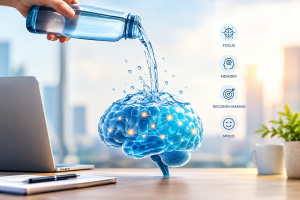
A water deficit of just 1.36% in healthy adults causes measurable impairment in mood, increases how difficult tasks feel, and reduces concentration, according to a landmark study published in the Journal of Nutrition by Armstrong and colleagues. For a person weighing around 150 pounds, that’s a deficit of less than three cups of water, an amount easily reached by mid-morning in a warm, air-conditioned office, well before anyone would describe themselves as thirsty.
Hydration doesn’t have the built-in appeal of a step-count challenge or a guided meditation session, and it’s easy to assume something this simple doesn’t need a place in a structured wellness program or app. But the research behind it is some of the most consistent and least disputed in the entire wellness category, which raises an obvious question: why does the most boring intervention keep outperforming far more exciting ones on the actual evidence, and how much more effective could it be once it’s actually built into the tools and programs already doing the work of engagement?
The Cognitive Cost of Mild Dehydration
Even small fluid deficits measurably impair thinking. Research consistently shows that depleting body water by as little as 1 to 2% begins compromising attention span, memory function, alertness, and decision-making capacity, well below the level most people would recognize as dehydration. A 2011 meta-analysis published in Nutritional Neuroscience by Adan found that dehydration at around 2% body weight loss significantly decreased vigilance, the sustained attention required for the kind of focused, error-sensitive work most knowledge jobs actually demand.
Reaction time and attention respond directly to hydration status. Research from the University of East London and the University of Westminster found that drinking water before cognitive tasks improved performance by up to 14% on tests of reaction time and attention, a meaningful gain for something that costs essentially nothing to provide.
Judgment and decision-making are affected too, not just alertness. Research on water supplementation after dehydration found that rehydration measurably improved judgment and decision-making performance, an area of cognition closely tied to executive function and the kind of complex reasoning most roles above entry level actually require. This matters because most wellness conversations about hydration focus on energy or headaches; the research suggests the deeper cost is to the quality of thinking itself.
Healthcare workers, an unusually well-studied population for this, show the pattern clearly. A 2026 scoping review covering 15 studies found that 60% reported reduced physical performance when dehydrated during shifts, and 53% documented declines in cognitive performance and mood, with the effect increasing on longer shifts, particularly among nurses working 12-hour rotations and residents working more than 24 hours. The review’s authors specifically noted this remains an under-researched area relative to its apparent impact, a pattern that likely holds across most other industries too.
Why Hydration Gets Overlooked Despite the Evidence
It hasn’t been given the same spotlight as more visible wellness formats, even though it’s easy to build in. Modern workplace wellness has understandably leaned into visible, trackable, engaging formats, step challenges, fitness app integrations, guided wellness events, because engagement and consistency are genuinely hard problems to solve otherwise. Hydration fits naturally into exactly this kind of structure, a simple daily tracker, a gentle in-app reminder, a friendly team-wide streak, but it’s often left as an afterthought feature rather than a headline one, even though it may be one of the easiest habits to actually sustain once it’s built into a tool people already check daily.
The symptoms are misattributed constantly. Mild dehydration produces fatigue, headaches, irritability, and difficulty concentrating, symptoms nearly identical to the ones commonly blamed on stress, poor sleep, or general burnout. An employee experiencing an afternoon slump is far more likely to reach for coffee or blame their workload than to consider that they simply haven’t had enough water since breakfast, and organizations designing wellness programs make the same attribution error at scale.
It feels too basic to be the headline of a program, even when it should be a core part of one. There’s a natural instinct to lead a wellness strategy with its most sophisticated-sounding features, since those are what tend to stand out in a benefits presentation. That instinct isn’t wrong, a well-designed app or a well-run wellness event genuinely helps people build better habits, but it works best when the fundamentals are built into that structure from the start, rather than assumed to take care of themselves underneath more visible features.
“In short, we keep looking for the next wellness innovation while overlooking one that’s been sitting right in front of us the whole time. The best programs don’t choose between the exciting features and the fundamentals, they build the fundamentals into the experience people already show up for.” — Mr. Amit Kapoor, Founder of Balanz & Beonn
The Case for Taking It Seriously as a Workplace Intervention
The cost-to-benefit ratio is unusually favorable. Unlike most wellness investments, which require ongoing subscriptions, vendor contracts, or significant behavior change, improving workplace hydration mainly requires access, visible water stations, chilled and appealing options, and reminders built into the environment rather than left entirely to individual memory during a busy day.
It compounds with other wellness efforts rather than competing with them. An employee who’s properly hydrated gets more benefit from a short movement break, sleeps somewhat better, and experiences less of the fatigue that undermines focus during long meetings. Hydration functions less like a standalone program and more like a foundational condition that determines how effectively everything else in a wellness strategy actually performs.
Errors and safety outcomes are directly at stake in some roles. In safety-critical positions, clinical care, machinery operation, transportation, aviation, even minor judgment lapses tied to dehydration-driven cognitive decline can produce serious consequences, making this a genuine risk-management issue in certain industries, not simply a comfort consideration.
Building Hydration Into a Genuine Wellness Strategy
Make water genuinely accessible, not just technically available. A single water cooler on a distant floor doesn’t meaningfully change behavior. Visible, convenient, appealing water access throughout a workspace removes the friction that otherwise causes people to simply forget until they’re already impaired.
Use the tools people already check daily to reinforce the habit. A hydration reminder or simple daily tracker inside a wellness app turns an easily forgotten habit into a small, visible part of someone’s routine, without requiring them to think about it as a separate initiative. This is exactly the kind of fundamental that a well-designed app can make effortless rather than aspirational.
Address the misattribution problem directly. Since dehydration symptoms are so easily mistaken for stress or poor sleep, brief education helping employees recognize the actual cause of an afternoon slump can shift behavior more effectively than infrastructure alone.
Treat hydration as core corporate wellness infrastructure, built into the same programs carrying everything else. A genuinely comprehensive wellness strategy weaves foundational physiological needs into its more visible initiatives, mental health support, fitness benefits, guided events, rather than treating hydration as a separate, lower-priority checkbox sitting apart from the rest of the program.
Corporate wellness events are increasingly being organised around exactly this kind of return to fundamentals, hydration and nutrition education sessions, habit-building challenges built around basics rather than novelty, precisely because the research keeps confirming how much impact the simplest habits actually have. Some organizations are working with a specialized corporate wellness company to properly integrate these fundamentals, sleep, hydration, movement, into a coordinated strategy, often using the same app and event infrastructure already driving engagement elsewhere in the program, rather than treating them as too basic to formally include.
The Bottom Line
Why might hydration be the most boring wellness trend that actually works? Because unlike many higher-profile wellness investments, the evidence behind it is remarkably consistent, methodologically solid, and points to real, measurable effects on cognition, mood, and error rates, for a habit that costs almost nothing to support once it’s built into the right structure. It will never be the single most exciting line in a benefits presentation on its own. But woven into a well-designed wellness app or a well-run wellness event, rather than left to sit quietly on the side, it may quietly be doing more work than most people realize, precisely because it’s the foundation everything else in a wellness program actually depends on.
There’s a useful lesson in that for wellness strategy more broadly: the fundamentals the research most consistently supports work best when they’re built into the same engaging structure driving everything else, not treated as a separate item running alongside it. Hydration doesn’t need to be the flashiest part of a program to matter. It just needs to be genuinely built in.


